Author: Aswad Aziz

  • Chemical Risk Assessment Malaysia: SDS, CHRA and USECHH Explained

    Chemical Risk Assessment Malaysia: SDS, CHRA and USECHH Explained

    Factory safety teams often have an up-to-date chemical register and a folder of Safety Data Sheets (SDS), yet still struggle to explain whether worker exposure is controlled. The missing link may be a task-specific assessment of how chemicals are used, and where relevant, a Chemical Health Risk Assessment (CHRA).

    Three chemical management concepts that must not be confused

    Safety Data Sheet (SDS)

    An SDS provides hazard information from the chemical supplier, including identification, classification, exposure controls, handling and emergency guidance. A useful SDS does not establish what concentration an individual worker inhales in your particular process.

    CLASS Regulations 2013

    The Malaysian CLASS Regulations regulate supplier responsibilities for classification, packaging, labelling, SDS and related chemical inventory information. Suppliers must provide hazard communication in accordance with the applicable regulations.

    USECHH Regulations 2000 and CHRA

    The USECHH Regulations concern workplace use and exposure to chemicals hazardous to health. They address assessment of health risks and the controls, instruction, monitoring and health surveillance that may be relevant in specific circumstances. A CHRA is a specialised assessment under this framework; a generic HIRARC worksheet is not automatically equivalent to one conducted in accordance with USECHH requirements.

    What should employers examine before a CHRA?

    1. Identify every relevant chemical and the tasks in which it is used.
    2. Confirm current SDS and hazardous ingredients where applicable.
    3. Review quantity, frequency, duration and route of exposure.
    4. Inspect engineering controls such as local exhaust ventilation and enclosure.
    5. Identify who may be exposed, including cleaning and maintenance workers.
    6. Check previous exposure measurements, incidents and worker feedback.

    Worked example: solvent cleaning at a workbench

    The SDS identifies potential inhalation and skin hazards. The site uses solvent for brief cleaning tasks, but daily frequency has increased after a production change. Management should reassess the exposure scenario, ventilation effectiveness, handling procedure and chemical health risk assessment obligations rather than assuming the original SDS resolves the new risk.

    Why PPE alone is insufficient

    Gloves, goggles and respirators can have a place in a control strategy, but selection depends on the substance, concentration, task and approved protection level. Where practicable, reduce exposure by substitution, enclosure, ventilation or process modification. Verify controls in operation and review when circumstances change.

    Competence and management follow-through

    Workers should know how to obtain current hazard information and apply approved handling controls. Managers must ensure resulting assessment recommendations are translated into funded actions with owners, dates and verification. Specialist CHRA work should be performed by appropriately qualified or registered personnel where required by current rules.

    Training and support

    See Chemical Management (USECHH Awareness) and Safe Chemical Handling programmes for practical worker awareness. A training course is not a replacement for the statutory CHRA service. Discuss your needs and determine the appropriate specialist scope.

    Official references

    DOSH Chemical Management: USECHH Regulations 2000, CLASS Regulations 2013 and CHRA guidance. Consult current regulatory texts and approved competency arrangements.

  • Overhead Crane Safety Training Malaysia: Lifting Checklist

    Overhead Crane Safety Training Malaysia: Lifting Checklist

    Overhead crane safety training in Malaysia should focus on the real lifting operation: people, load, equipment, space and communication. A load may be within the crane’s rated capacity but still present serious risks if it is incorrectly slung, unstable or moved over an occupied work area.

    Start with a lifting risk assessment

    Consider load mass and centre of gravity, attachment points, sling angles, travel route, obstructions, visibility, nearby operations and space for landing. Review the crane’s technical limits and whether lifting appliances and accessories are suitable, inspected and subject to any applicable statutory requirements.

    Seven essential lifting checks

    1. Plan the lift: Establish the load path, destination and method before lifting.
    2. Verify equipment: Check identification, rated capacity, inspection status and visible defects.
    3. Inspect accessories: Check slings, hooks, shackles and connections for suitability and condition.
    4. Confirm roles: Identify the operator, slinger and signaler and agree their responsibilities.
    5. Protect people: Control the lifting and travel zone to prevent exposure to suspended loads.
    6. Lift safely: Check balance with a controlled initial lift and follow the agreed route.
    7. Land and secure: Ensure the load is stable before releasing lifting gear.

    Communication can prevent a serious event

    Where the operator cannot see the entire load path, designated communications and a competent signaler become critical. Use an agreed standard of hand signals or radio language. Stop if instructions are ambiguous or communication is lost; never guess the intended movement.

    Why does sling angle matter?

    Changing sling geometry changes leg tensions. The load’s total weight alone does not establish that every sling and connector is within its limit. Qualified personnel should determine the lifting arrangement using appropriate technical information; avoid estimating based on appearance.

    Common unsafe behaviours

    People walking under a suspended load, hands placed between a load and a fixed object, standing in a pinch point, side-loading a hoist, dragging a load and bypassing limit devices are serious warning signs. Correct these through physical arrangements, proper planning and supervision—not posters alone.

    How to assess operator competence

    Use realistic checks: interpreting rated capacity information, inspecting the crane, using controls smoothly, responding to stop signals, keeping the exclusion area clear and handling a simulated abnormal condition. A classroom quiz alone is not enough to demonstrate hands-on competence.

    Is a one-day crane course enough?

    A one-day course may suit awareness or refresher requirements for experienced personnel with an appropriate assessment scope. Novice operators may require more supervised practice and evaluation. The employer must match training and authorisation to equipment, task and risk; avoid a universal promise that attendance guarantees competence.

    See Overhead Crane Safety training or enquire about practical training for production, warehouse and maintenance teams.

    Reference

    Malaysia Department of Occupational Safety and Health. Verify applicable current plant and lifting equipment requirements, manufacturer instructions and approved lifting procedures.

  • Lockout Tagout Malaysia: A Practical LOTO Safety Checklist

    Lockout Tagout Malaysia: A Practical LOTO Safety Checklist

    Lockout Tagout (LOTO) protects workers when machinery is being inspected, maintained, cleaned or repaired. Switching equipment off at the local push-button is not necessarily a safe isolation. Hazardous energy may remain in electrical circuits, hydraulic accumulators, pressurised lines, gravity-loaded parts, springs or rotating equipment.

    Why is LOTO necessary?

    A machine can start unexpectedly when an automated signal is received, another person presses a control or stored energy is released. Effective isolation identifies every relevant energy source and prevents unplanned energisation. General employer duties under Malaysia’s Occupational Safety and Health Act 1994 include safe systems of work and appropriate information, training and supervision.

    Understand all energy sources

    • Electrical: Main supply, backup circuits, capacitors and multiple feeds.
    • Mechanical: Rotating parts, springs and suspended components.
    • Hydraulic and pneumatic: Pressurised fluids, hoses and actuators.
    • Thermal: Hot surfaces, steam and residual heat.
    • Process: Pressurised or hazardous materials and connected transfer lines.

    Seven practical isolation steps

    1. Plan: Identify equipment, scope, isolation points, exposed people and relevant permits.
    2. Notify: Tell affected workers and confirm the equipment can be stopped safely.
    3. Shut down: Follow the approved sequence for normal stopping.
    4. Isolate: Use the specified isolation devices, not just a control switch.
    5. Secure: Apply personal locks and tags according to the authorised site procedure.
    6. Release and verify: Control stored energy and prove a zero-energy state using safe, appropriate tests.
    7. Restore: Account for people and tools, check guarding, remove locks under authorised rules and communicate return to service.

    Verification is the critical step

    A lock and tag tell people an isolation is intended; they do not prove it is effective. For electrical equipment, verification may require suitably competent personnel and appropriate instruments. For pressure systems, it may mean verifying depressurisation and ensuring that pressure cannot re-accumulate. Always use approved site instructions.

    Common LOTO failures

    Typical problems include an incomplete isolation boundary, shared keys, unrecognised stored energy, unclear group lock arrangements and return-to-service pressure. Another failure is assuming a contractor understands the host company’s isolation method without an interface briefing.

    Group isolation and shift handover

    When multiple people or teams work on the same plant, a group lockbox and formal handover may be required by the employer’s approved system. Every exposed person needs protection throughout the work. Removal of another person’s lock requires a tightly controlled exception process—not informal permission.

    Training should use the real equipment

    An effective exercise asks employees to identify energy points, explain their isolation boundary, demonstrate verification and describe their responsibilities during transfer of work. The learning objective is competence in the site’s system, not memorising the letters LOTO.

    Explore Permit to Work and LOTO training, or request a workplace-based workshop.

    References

    Malaysia DOSH and Occupational Safety and Health Act 1994 (Act 514), including general duties and risk assessment. Refer to the applicable machine-specific rules and authorised isolation procedure; this checklist is not itself a statutory LOTO sequence.

  • How to Choose an HRD Corp Accredited HSE Trainer in Malaysia

    How to Choose an HRD Corp Accredited HSE Trainer in Malaysia

    When selecting an HSE trainer in Malaysia, the cheapest quotation is not always the best training investment. Effective procurement should establish whether the trainer understands your operational risks, can engage the workforce and can produce credible evidence of learning.

    Start with the workplace problem

    Before contacting providers, define the reason for training. Is the objective awareness, improved supervision, task competence, compliance with an applicable scheme, or reducing repeated workplace failures? Each objective requires different content, duration, facilities and assessment.

    Check professional credibility

    Review the trainer’s relevant experience, qualifications, current accreditation where required and familiarity with the target industry. A certificate is useful evidence, but ask what worksite problems the trainer can explain and how they adapt examples for participants’ roles.

    HRD Corp accredited does not mean every course is automatically claimable

    HRD Corp accreditation refers to a trainer’s status within the HRD Corp training landscape. Claimability depends on the applicable scheme, employer eligibility, grant approval, programme and training-provider registration, levy availability and current rules. Verify the status of the complete training arrangement before promising a claim.

    Eight questions to ask before booking

    1. What specific learning outcomes will participants demonstrate?
    2. Is the outline adapted to our site, equipment and risk profile?
    3. How is practical competence assessed where needed?
    4. What are the trainer’s relevant field credentials and experience?
    5. What training aids, equipment and facilities must we provide?
    6. Will pre- and post-training assessment results be supplied?
    7. What records or end-of-training report are included?
    8. Who is responsible for HRD Corp submission and claims documentation?

    Training provider considerations

    If engaging an associate trainer, agree whether the assignment covers trainer-only delivery or a complete package. Define course material ownership, branding, client communication, assessment responsibilities, confidentiality, reporting formats and document delivery deadlines.

    What a useful end-of-training report looks like

    An effective report should identify programme scope, participants, delivery date, assessment method, learning outcomes achieved and training limitations. If a site-based exercise generates improvement suggestions, distinguish participant observations from trainer-verified findings, with management ownership of any follow-up actions.

    Example: forklift training procurement

    For experienced operators, a short refresher with practical verification may suit the need. For inexperienced people, substantially more supervised skill development could be necessary. A trainer who claims every situation needs the same course duration without reviewing the learners and equipment deserves further scrutiny.

    Discuss a training partnership

    Aswad Aziz is an HRD Corp Accredited Trainer with industrial and offshore HSE experience. View the trainer profile, explore programmes and use the dedicated training-provider engagement pathway or corporate enquiry.

    Official references

    HRD Corp: Trainers and HRD Corp: Claimable Courses. Review current scheme-specific requirements before submitting an application.

  • Toolbox Talk Communication: Why Safety Messages Fail

    Toolbox Talk Communication: Why Safety Messages Fail

    A toolbox talk can be completed, signed and filed without anyone genuinely understanding the risk. The problem is rarely that the speaker did not talk enough. It is that the message failed to connect with the actual task, the people and the conditions of the day.

    Why workers stop listening

    Common causes include repeated generic messages, unclear jargon, one-way lecturing, talks delivered far from the job, time pressure and a lack of opportunity to question impractical controls. An effective briefing is a short operational conversation, not a speech for compliance records.

    Begin with the actual job

    Ask: What are we doing today? What could seriously hurt someone? What is different from the last time? Who may be affected? Discuss site interfaces such as contractors, vehicle movement, lifting zones, permits, weather and temporary changes.

    The three-part safety communication model

    1. State: Communicate the specific hazard and the required control in plain language.
    2. Check: Ask a worker to explain the control or show where it applies.
    3. Confirm: Clarify who will verify it and what conditions require work to stop.

    For example, “Watch out for forklifts” is vague. “All pedestrians use the yellow gate during loading; the supervisor verifies the barrier before movement starts” is specific and observable.

    Use two-way and three-way communication

    For routine briefings, two-way communication ensures questions can be asked and answered. During critical instructions, a three-way exchange can reduce ambiguity: sender states the instruction, receiver repeats the meaning, sender confirms or corrects it. This technique is particularly useful where noise, language differences or changing conditions could create misunderstandings.

    Practical engagement techniques

    • Show a photograph of the actual task instead of a generic poster.
    • Invite a frontline worker to describe one realistic failure scenario.
    • Ask what would make the crew stop or escalate the job.
    • Have the team demonstrate the control before beginning work.
    • Capture one unresolved concern and assign an owner.

    What should a supervisor measure?

    Do not use attendance alone as the indicator of briefing quality. Observe whether workers can identify the main exposure, state the critical control, explain the stop-work trigger and recognise who to contact when work changes.

    Case example: shared lifting area

    A supervisor explains that the exclusion zone must remain clear. One crew member points out that another team plans to cross the area to reach its equipment. Instead of rushing the briefing, the teams agree a temporary alternative route and an interface control before lifting begins. That conversation creates more safety value than a completed attendance form.

    Improve your safety conversations

    Aswad Aziz offers practical facilitation integrating communication principles with safety and leadership training. Discuss a customised workshop for supervisors or frontline teams.

    Related reading

    TBRA vs HIRARC: making pre-task controls practical.

  • AI for HSE Professionals Malaysia: Practical Uses and Risks

    AI for HSE Professionals Malaysia: Practical Uses and Risks

    AI for HSE professionals can speed up preparation of training activities, draft checklists and organise information. It cannot see your worksite, approve a high-risk task or replace professional judgement. That distinction matters because an impressive-looking AI answer can still be technically wrong.

    Where AI can add real value

    For a competent HSE practitioner, generative AI works best as a drafting and review assistant. Examples include: structuring a safety briefing, turning approved technical notes into simpler language, drafting incident interview questions, creating a training quiz, comparing two versions of a procedure or organising a large set of inspection observations into themes.

    Five HSE applications worth piloting

    1. Toolbox talk preparation: Prepare a short talk using a verified job hazard and site control list.
    2. Training: Draft scenarios, knowledge checks and facilitator notes, followed by expert review.
    3. Incident learning: Sort anonymised evidence into a timeline without asking AI to invent root causes.
    4. Risk review: Challenge whether a control is specific, owned and verifiable; confirm every technical suggestion independently.
    5. Reporting: Draft concise action summaries from approved data, retaining human responsibility for conclusions.

    Where AI should not be the decision-maker

    Do not delegate permit approval, lifting calculations, legal compliance decisions, emergency diagnosis, medical decisions or verification of controls to a chatbot. Technical calculations, Malaysian legal references, standards and equipment specifications need reliable source validation by an appropriately competent person.

    Protect confidential information

    Workers’ personal data, client drawings, incident records, contractor details and unpublished procedures may be confidential. Use a company-approved platform and data-handling agreement. Anonymise examples properly, avoid uploading identifiable information without authorisation and check retention and sharing arrangements.

    A practical AI quality-control workflow

    1. Define: State the exact purpose, source material and required output.
    2. Generate: Ask the model to identify assumptions and unknowns rather than fill gaps.
    3. Verify: Check against current legislation, approved procedures and original references.
    4. Approve: Assign an accountable subject-matter reviewer.
    5. Record: Keep material review changes where the output influences an operational decision.

    Example prompt for training preparation

    “Using the following approved workplace risk assessment only, draft a 10-minute toolbox talk for new forklift operators. Include the hazard, required control, a two-way comprehension check and three questions. Mark any missing site facts as NEEDS VERIFICATION. Do not invent legal requirements.”

    This approach makes AI assistance transparent and reviewable.

    Training for practical adoption

    Explore the AI for HSE Professionals workshop for supervised use cases, safer prompting and quality checks, or enquire about a programme.

    Further reading

    NIST AI Risk Management Framework and Generative AI Profile. This is a risk-management reference, not Malaysian occupational safety legislation.

  • TBRA vs HIRARC Malaysia: When Should You Use Each?

    TBRA vs HIRARC Malaysia: When Should You Use Each?

    HIRARC and Task-Based Risk Assessment (TBRA) are often discussed as if they are competing systems. They are better understood as complementary ways to identify risks and select controls at different levels of detail.

    What is HIRARC?

    HIRARC—Hazard Identification, Risk Assessment and Risk Control—is a structured method promoted in DOSH guidance. Organisations often use it for processes, departments or recurring activities. A warehouse HIRARC may cover vehicle movement, manual handling, chemical storage and routine maintenance.

    What is TBRA?

    TBRA focuses on a particular task, sequence, location and set of conditions. The terminology and form vary by employer: some workplaces call it a Job Safety Analysis (JSA), Job Hazard Analysis (JHA) or task risk assessment. A TBRA should capture site-specific interfaces that a broad register may miss.

    For example, the baseline register may say “lifting operation—suspended load”. The task assessment asks: Which load? Which lifting path? What obstacles, weather limitations, people, ground conditions and nearby operations exist today?

    How do they work together?

    Question HIRARC TBRA
    Scope Recurring activity or process Specific job and conditions
    Typical timing System design and periodic review Before the task and after change
    Focus Baseline hazards and controls Job steps, interfaces and verification
    Use with PTW? Supports system controls Can inform permit precautions

    Five steps for a good TBRA

    1. Define job boundaries and explain the intended outcome.
    2. Break the work into meaningful steps, including setup and reinstatement.
    3. Identify hazards for each step and any simultaneous work nearby.
    4. Select controls according to the hierarchy and assign verification responsibility.
    5. Brief the actual team, confirm understanding and revisit the assessment when conditions change.

    Practical example: maintenance beside forklift traffic

    The original HIRARC identifies pedestrian–vehicle collision risk. During maintenance, a contractor needs to remove a guard beside an active travel lane. The TBRA adds a temporary exclusion zone, confirmed traffic diversion, isolation boundaries, communication between operations and maintenance, and supervisor checks before work begins.

    Simply copying the original HIRARC row into a task form would not identify those temporary interfaces. The job briefing should ask workers what will make them stop and who can authorise a restart.

    Is a TBRA a separate statutory requirement?

    Malaysia’s Section 18B of the Occupational Safety and Health Act 1994 requires risk assessment and necessary controls. It does not prescribe TBRA as a universally named form. Employers should use a suitable risk assessment approach consistent with the law, relevant rules and contractual or site requirements.

    Training that uses a real task

    Effective HIRARC and TBRA workshops ask each group to assess one realistic job and defend its controls, instead of just completing a scoring table. Request a practical workshop.

    Official references

    DOSH Malaysia, Guidelines for Hazard Identification, Risk Assessment and Risk Control (2008), and Occupational Safety and Health Act 1994 Section 18B.

  • Working at Height Safety Malaysia: Controls Before Harnesses

    Working at Height Safety Malaysia: Controls Before Harnesses

    Many workplace teams approach working at height (WAH) with a simple instruction: wear a safety harness. That is incomplete. Fall prevention begins by questioning why the work must be done at height, whether collective protection is available, and what happens if a person falls.

    Is every job below two metres automatically safe?

    No. DOSH explains that Malaysian legislation does not give one universal definition of working at height. A fall through a floor opening or onto a dangerous surface may cause serious injury even at a lower elevation. The DOSH working-at-height guidance emphasises preventing falls by considering the actual risk, not relying on a simplistic height threshold.

    Use a hierarchy of fall controls

    1. Avoid: Move inspection, cleaning or assembly work to ground level if reasonably practicable.
    2. Prevent: Use suitable permanent access, working platforms, guardrails and barriers to prevent a person from reaching an unprotected edge.
    3. Reduce consequences: Where falls cannot be prevented, select appropriate fall protection or arrest systems and plan rescue.

    Assess the real work area

    Review leading edges, skylights, brittle roof sheets, openings, weather, access routes, dropped objects, electrical proximity and other trades operating below. Inspect the supporting structure and verify that work platforms or temporary access equipment are appropriate for the load, environment and activity.

    Choosing between ladders and work platforms

    Ladders are not a universal substitute for a designed platform. Consider task duration, reach, force applied, need for two hands, stability and evacuation. Use suitable inspected equipment and prevent overreaching. Where the work requires materials handling or sustained activity, an appropriate work platform may provide better control.

    Harnesses, anchorages and rescue

    Where personal fall protection is justified, verify compatible equipment, anchorage suitability, fall-clearance calculations, inspection and user capability. Attaching a lanyard to an unverified handrail can introduce rather than solve a risk. A fall-arrest setup must include prompt rescue arrangements; calling an external emergency service without a realistic retrieval plan may be inadequate.

    Practical example: servicing a rooftop unit

    Rather than beginning with PPE selection, assess whether the equipment can be relocated, whether guarded access is available, how materials reach the roof and whether fragile areas can be isolated. Address other hazards such as electrical isolation and heat exposure. The WAH risk assessment should connect to any relevant permit-to-work and emergency arrangements.

    What should WAH training demonstrate?

    Participants should recognise fall hazards, select appropriate controls, inspect access equipment, understand fall protection limitations, raise stop-work concerns and explain the emergency response sequence. Practical activities should be matched to the individual’s role and approved site equipment.

    Explore Working at Height training or discuss a site-specific session.

    Reference

    DOSH: Working at Heights and applicable current legislation and worksite procedures.

  • Chemical Handling and Spill Response Training in Malaysia

    Chemical Handling and Spill Response Training in Malaysia

    Chemical handling training in Malaysia should do more than teach workers to recognise hazard pictograms. An effective programme helps employees understand the chemicals they actually use, recognise exposure routes, prevent releases and respond safely when something goes wrong.

    Which Malaysian chemical safety rules matter?

    The CLASS Regulations 2013 establish supplier duties concerning classification, labelling and Safety Data Sheets (SDS). The USECHH Regulations 2000 address employers’ controls for exposure to chemicals hazardous to health, including risk assessment and appropriate information, instruction and training. The two sets of requirements serve different purposes; a labelled container is not itself proof that worker exposure is controlled.

    Start with a chemical inventory and actual tasks

    Identify the substances handled, their quantities, storage locations, transfer methods, waste streams and groups potentially exposed. Observe routine mixing, decanting, cleaning and maintenance. Check whether contractors work nearby and whether ventilation operates under realistic conditions.

    A solvent used in a small cleaning activity may pose inhalation and fire risks. A concentrated corrosive could create splash injury during pouring. Training examples should reflect these differences rather than treating all chemicals as one category.

    Five checks before a worker handles a chemical

    1. Identity: Confirm the product label against the intended substance; never rely on the appearance of the liquid.
    2. Information: Read the relevant SDS, especially hazard identification, controls, incompatibilities and emergency information.
    3. Exposure control: Check ventilation, closed transfer, secondary containment and safe handling arrangements.
    4. PPE: Confirm selected protection is suitable for the chemical and task; a generic glove may not be resistant to that substance.
    5. Response: Know the alarm, eyewash or emergency shower arrangements and who is authorised to manage a release.

    Responding to a chemical spill

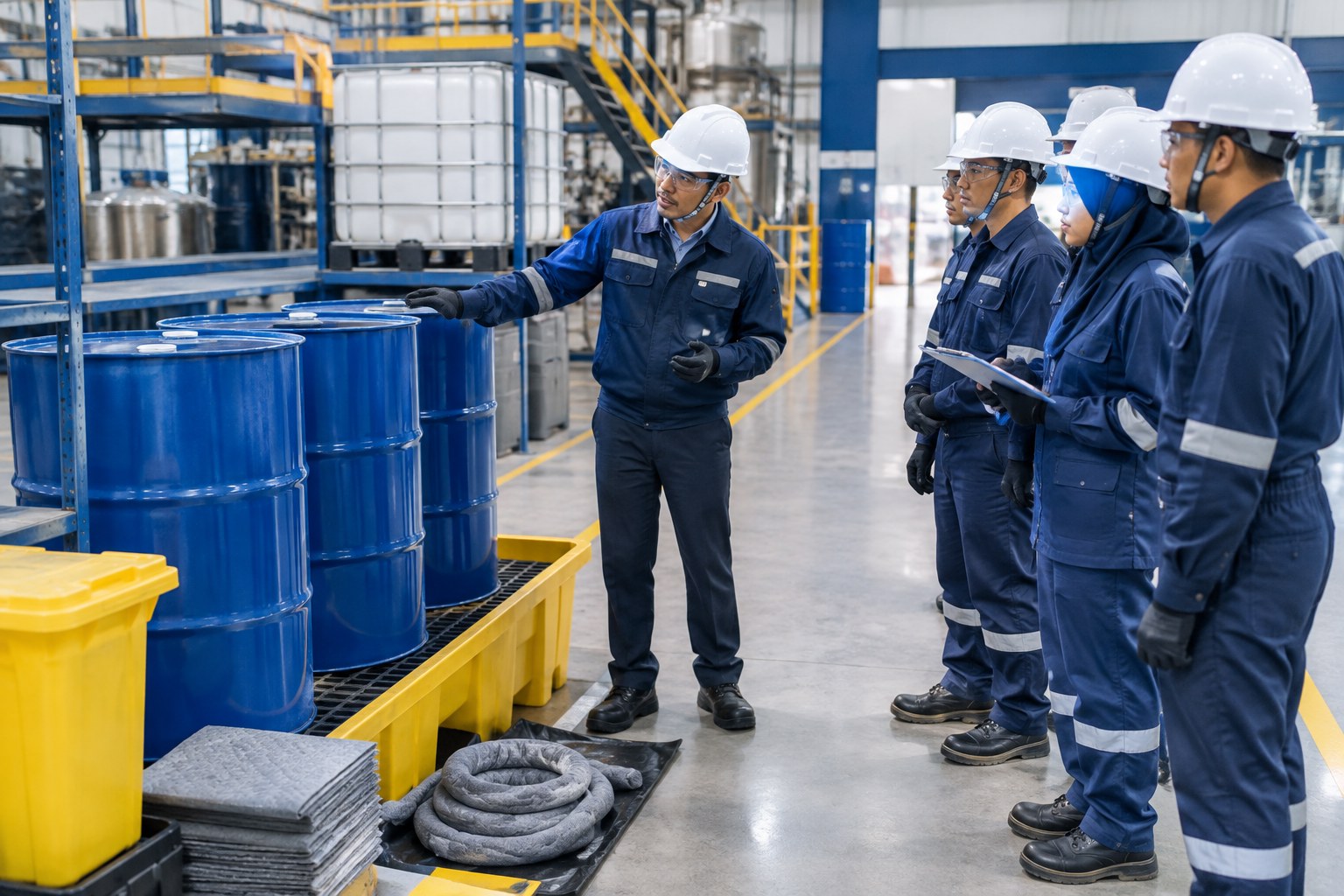
    For a spill, alert others and isolate the immediate area. Identify the substance without entering the danger zone. Use the SDS and site spill procedure to determine whether trained responders can deal with the release. Unknown materials, toxic vapours, significant fire hazards or quantities beyond the site’s capability require escalation and specialist response. Do not attempt to neutralise or mix chemicals without an approved procedure.

    Only trained and suitably equipped people should conduct containment or clean-up. Used absorbents and contaminated materials need appropriate waste classification and management.

    Training effectiveness: test performance, not attendance

    Ask participants to locate hazard information on a real SDS, choose a safe handling method, identify incompatible storage and explain an emergency escalation decision. Include a practical demonstration where it is safe and appropriate. An attendance certificate by itself does not establish site-specific competence.

    Management checklist

    • Is the chemical inventory current?
    • Are current SDS accessible at the point of use?
    • Are exposure assessments and controls suitable for actual use?
    • Have emergency equipment and spill procedures been checked?
    • Are training and refresher needs based on exposure and changes?

    Discuss a practical chemical safety workshop

    See Safe Chemical Handling and Spillage Control, or request a customised training proposal for your manufacturing, warehouse or maintenance team.

    Official references

    DOSH Chemical Management: CLASS 2013 and USECHH 2000 resources. Apply current regulations and site-specific SDS instructions.

  • Forklift Training Malaysia: Competency, Safety and Road Use

    Forklift Training Malaysia: Competency, Safety and Road Use

    Malaysian employers frequently ask whether forklift training must last five days or whether a certificate alone makes a person legally competent. The safer approach is to separate statutory duties, the workplace’s equipment risks and evidence of operator competence.

    Is five-day forklift training mandatory?

    There is no universal five-day forklift course duration prescribed for every forklift operator under Malaysia’s general Occupational Safety and Health Act 1994. A client, industry or specific regulatory scheme may set additional conditions. Course duration should be appropriate to prior experience, truck type, site hazards and assessment requirements—not chosen solely for certificate appearance.

    What must an employer ensure?

    The employer’s general duties under Section 15 of Act 514 include, so far as practicable, suitable information, instruction, training and supervision. Section 18B requires assessment of safety and health risks and implementation of necessary controls. For a forklift operation, this means assessing the machine, load, travel routes, pedestrians, ramps, charging or refuelling, maintenance and visibility.

    Training versus authorisation

    A training certificate documents participation or an assessment outcome; it does not by itself authorise operation at every workplace. The employer should verify practical performance on the relevant truck type, record any restrictions, and issue site-specific authorisation under its procedures.

    Suggested practical competence checks

    • Pre-use inspection, defect reporting and isolation of unsafe equipment.
    • Safe mounting, travel, turning, parking and load stability.
    • Operating within the rated capacity and attachment limitations.
    • Managing pedestrian interface, blind corners and reversing.
    • Responding to an abnormal condition and following the approved emergency procedure.

    Can a forklift drive on a public road in Malaysia?

    Workplace forklift competence is not automatically permission to operate on a public road. Public-road use raises separate Road Transport Act 1987 and JPJ questions about vehicle classification, registration or exemptions, insurance, operator licensing and roadworthiness. Do not assume that a normal car licence or forklift course alone establishes compliance. Confirm the exact machine and proposed journey with JPJ and your insurer before the forklift enters a public road.

    How to reduce forklift incidents

    Separate pedestrians from truck movement using physical barriers and controlled crossings wherever practicable. Keep aisles clear, manage reversing visibility and set site-appropriate speed and load rules. Review near misses and verify controls during operational inspections.

    Frequently asked questions

    Can an inexperienced employee attend a one-day course?

    An awareness session may fit one day, but an inexperienced operator could need substantial practical training and supervised development before a defensible competence assessment. Match training depth to skill and risk.

    Is a refresher course always required annually?

    Do not confuse company refresher schedules with a universal statutory expiry period. Plan reassessment after incidents, equipment changes, unsafe performance, lengthy inactivity or other significant changes; follow specific applicable rules and client requirements.

    Forklift training enquiry

    Aswad Aziz provides forklift safety programmes with practical workplace relevance and assessment scope agreed in the approved course outline. Request a corporate programme.

    Official reference

    Act 514, Sections 15 and 18B. For public-road questions refer to Jabatan Pengangkutan Jalan (JPJ) and current road transport requirements.